«I am the only Cibrán Xiran I know, and I speak Chinese, Galician, Spanish, and English»

VEN A GALICIA
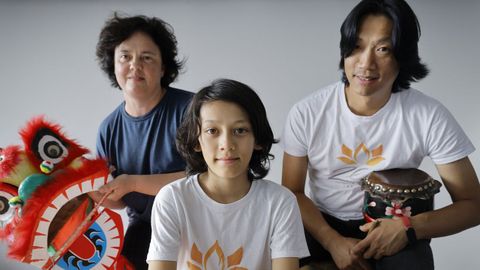
Love for languages is what the members of this «Galichinese» family show, living day-to-day with a natural blend of languages and cultures
29 oct 2026 . Actualizado a las 19:52 h.Saint James did not arrive in a stone boat in Hangzhou, the capital of Zhejiang province, but Hangzhou is essentially «the Compostela of China», according to the comparison made of this number-one cultural destination in the Asian giant by the half-Galician, half-Chinese family formed twenty years ago by Vero López and Rui Guo. For the past ten years, there have been three of them, because on this multicultural team their son Cibrán also «plays», bright as a dolphin even though in the Chinese zodiac he is a Fire Monkey. «I appear in the background alongside 81 other people in a video for a Pakolas song for five seconds», points out this kid from the Xabarín Club who grew up in Galician at school, CEIP de Caión.
Rui, Cibrán’s father, is the Eastern side of the family living in Arteixo, managing day-to-day life at home in multiple languages. The only language they use outside the house but not in the domestic space of the home is English.
Cibrán, at 10 years old, is a lifelong Galician; he has spoken Chinese since he first began making sounds, and for as long as he can remember, he has trained in the body philosophy of kung fu. But it wasn't until he was 9 that he visited the place where his father comes from, a village in Qingtian near Shanghai. It is the village of Sapu, and at first glance, it is hard to see any resemblance to Santaia de Chamín, the village in Arteixo where this «Galichinese» family lives, though Rui hesitates and ultimately decides that «here too there is an unbroken line of houses between Chamín and Monteagudo».
In his native village, there is no separation between houses; «it's a continuous line», explains this computer engineer who has lived in Galicia for three decades, speaks Galician, and considers himself «more Galician than Spanish, without one taking away from the other», he concludes. His Chinese hometown is one of emigrants. «A large part of the Chinese population in Europe comes from that municipality», an Eastern place where you can eat cured ham and drink Rioja wines. «In fact, we went to a Spanish bazaar there», sparks a recent memory in Cibrán, who carries part of his identity, cousins, uncles, aunts, and great-uncles in his southern Eastern homeland. The paternal grandparents came to Galicia when Rui was already a boy. So they are not Galician by birth, but one hundred percent raised Galician.
Last summer, Cibrán's Chinese grandmother also flew back to Qingtian with the family. «A lot of people from here left for Spain and other European countries, and in the summer they come back with the kids», comments Vero.
«Nature, the way people say things, the humor—they are similar in China and in Galicia. Galicia is a wonderful place to understand the Chinese mindset, its subtleties»
Polite and hearty eaters
Rui knows how to handle morriña (homesickness). As an adult, he lived in China for a year for work, in this case in the northern part of the country. Before the COVID pandemic, he also used to travel to the Shanghai area, but his immediate family is here; they are all Galician. In climate and personality, there is something shared between Qingtian and Galicia, Rui concedes. «Qingtian is also a green area, despite being urban», says Vero. And Rui: «They are similar to Galicians: politically polite. And they love to eat».
«I see more similarities between China and Galicia than with the character of Castile. That way they have of saying and understanding things, in an indirect way, with irony», Vero reflects. In Rui's town, in the villages nestled along the mountain slopes, several dialects coexist. «They have one dialect for Qingtian, the large municipality, and another for Sapu. It's as if there were one language for Barrañán and a completely different one for A Coruña», explains Cibrán, whose comparisons hit the mark. «Nature, the way people say things, the humor—they are similar. Galicia is a wonderful place to understand the Chinese mindset.
They, like Galicians, are not direct at all, which is why many people from other regions of Spain find it hard to understand the Chinese mentality and its subtleties», emphasizes Vero. Rui chimes in to qualify that in China the story also changes from north to south: «In the north they are more direct, and in the south much less so».
The couple met through friends. It was at university, while she was studying sociology and he was studying computer engineering. Vero and Rui have been together since 2006, so they are celebrating twenty years of relationship and ten years of a son who is the happy blend of the two cultures and traditions embracing within him. Cibrán also has a Chinese name, Xiran («with no accent mark or unusual characters»).
«My dad wanted to call me Josito [Rui bursts out laughing as Cibrán shares the anecdote]. But in the end, I'm Cibrán Xiran. I'm the only one I know», reveals this subscriber to the Galician newspaper from the Costa da Morte, O Papagaio, the paper for young people, whose teacher at school is musician Jose Carballido, who blends metal and muiñeira in his band, A Sombra dos Soños.
«At home we speak Chinese, Spanish, and Galician —says Cibrán, who is also a fan of Fran Amil and Pakolas—. My dad speaks to me in Chinese and I answer half in Chinese and half in Galician or Spanish». Galician was the language in which Vero, 51, was raised, originating from Sarria, with Galician-speaking parents and grandparents. In adolescence, Vero began speaking Spanish, because her parents grew up playing in Galician, but were educated under the compulsory use of Spanish.
With Chinese and Spanish predominantly at home, and Galician with gheada as the everyday language at CEIP de Caión, where he just finished his studies, grew up Cibrán, who doesn't care for soccer, but loves comics, movies, and kung fu.
«Of all the languages I know, Galician is the one I like best», he says. Even though his mother had to take Chinese classes when he was very little so as not to miss out on the conversations between father and son.
Playing a round of Uno in Chinese in collusion with his dad is one of the pastimes of this linguistically gifted kid, who wants to get better at English. «Because we study English outside, but in our house, it isn't anyone's native language», Vero clarifies.
In this multilingual family, people don't ask about age, but rather one's sign—the Chinese zodiac, of course! So if they ask you «how old are you?», you say «Fire Snake». And let them do the math if they want...