Aleksandr, from Russia in love for Galician: «In Madrid, some took me for a Galician because of my accent»

VEN A GALICIA
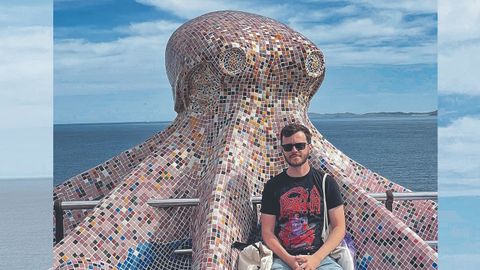
This Rostov-born philologist is the author of a Galician-Russian dictionary that is now in its third edition in five years, as well as the translator of Doctor Zhivago. «I think I've read more books in Galician than in Spanish», estimates this lover of Rosalía's language. These stories of new speakers demonstrate an interest in our language that reaches as far as the Far East
20 oct 2026 . Actualizado a las 16:07 h.From Russia with love, on the other side of the screen, speaks Aleksandr Dziuba (Rostov, 1990). Love for Galician and for Galicia, a place where this teacher and translator of Doctor Zhivago returns whenever he gets the chance. Before making his debut in Galician, Aleksandr already spoke Spanish. «When I studied at the University of Alicante, we had some courses. There I discovered Bágoas negras, an album of Galician and Asturian music dedicated to the Prestige catastrophe», tells Aleksandr, who discovered that album in 2010.
Seven years later, he came across the record again and decided to translate a song «with the lyrics of a cantiga by Rui Fernandes». At that time, he was a professor of Romance Philology and knew «a little Portuguese and a bit of Spanish». He wanted to learn Galician online, but found «nothing, just an old webpage that didn't work well on a modern computer».
In 2019, an opportunity arose that he couldn't pass up: going to A Coruña to work as a language assistant. «Back then, I thought that to live in Galicia I had to learn Galician», he says. And to build up a proper vocabulary, he began creating a Galician-Russian dictionary. Today, that dictionary with 21,000 entries is in its third edition in five years.
Are Russian and Galician similar? «Some words are, but most aren't», answers Aleksandr, who notes that there is an interest in Russia for Galicia and its language.
He currently has six Galician students, «and most of them already spoke Spanish or Portuguese; they have a foundation».
Aleksandr would love to live in Galicia. «I liked the Galician way of life—you are warm and affectionate. The food, wonderful. The rain can be a bit wearing, but everything else is great —he reflects—. From the beginning, I noticed that melodic intonation in the speech... And I think I picked up a bit of a Galician accent even when I speak Spanish. There were people in Madrid who took me for a Galician».
Today, Aleksandr speaks Galician daily with an American friend who is fond of the language, Noah Chichester, creator of the first web portal dedicated exclusively to Galician wines. But he admits he misses speaking it more, with more people, he clarifies.
This linguist from Rostov never experienced a foliada (traditional party) due to the COVID-19 pandemic. He coped with the lack of wild feasting through literature. «I think I've read more books in Galician than in Spanish —he calculates—. I really liked Castelao. I translated a short story that never ended up being published. I loved A esmorga and also Memorias dun neno labrego». When we speak, he does not yet know that Neira Vilas will be honored on Galician Literature Day in 2027.
He likes Vicente Risco less, he admits. «But he helps with making the dictionary! Because I include words that are not recognized by the RAG, but appear in books. In Risco, you can find a lot of words that the RAG does not accept. I want people to know that they exist in literature», states this fan of Manuel Rivas.
Aleksandr was a contender for the Plácido Castro Award for translating most of the 700 pages of Doctor Zhivago, and he has translated Gogol's short stories into Galician.
«If I could, I would go to Galicia all the time», expresses this lover of Galician, who invites people to overcome «the self-hatred that limits minority languages». If Galician is a person's mother tongue, that is what matters, regardless of whether it is useful or not... Your language is what distinguishes you from other people», believes Aleksandr.
There are Russian words that have no translation, he says, «and things that only exist in Galician». Even if Pasternak and Gogol feel right at home in the language of Galicia.