From Massachusetts to Corcubión: «Our connection with the Costa da Morte was love at first sight, it is wild and fascinating»

VEN A GALICIA
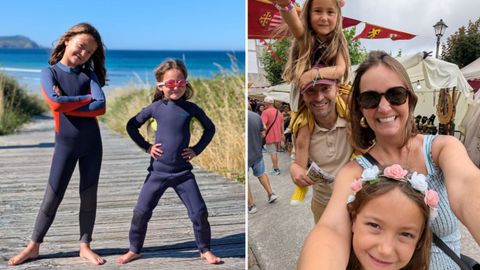
When she was in college, Lucia Parker was a young pilgrim on the Camino de Santiago: «In that experience Galicia captivated me»
06 oct 2026 . Actualizado a las 21:30 h.In the middle of July, a family from Massachusetts stepped back into the Middle Ages for two days on the Costa da Morte. The DeMarco Parkers enjoyed their first vacation in Corcubión last summer and fell in love at first sight with the place where the land ends and the sea never does. What captivated them about this place, they share, was the temperament of its people and the force of the Atlantic on beaches that are not as crowded as those back home.
Lucia Parker, 39; her husband, Michael DeMarco, 42; and their daughters, Margaret and Susanna, aged 7 and 5, have chosen once again—for the second time this year— the coast that inspired Loewe's collaboration with net makers (redeiras) for one of its handbag collections. The waves of the Costa da Morte were mostly to blame. A shared passion for surfing was one of the reasons this family from Newburyport, a city in Essex County, Massachusetts, decided to spend a long four weeks in Corcubión. In Newburyport, they explain, there are beaches and they do have waves, but they lack the power of those at Nemiña, one of their favorite surf spots in the area.
«We came to the Costa da Morte for the first time in July 2025 and fell in love at first sight,» Lucia confesses a few days before their return trip to Massachusetts on July 25. The area's landscape, its people, the local festivals and fairs, as well as the gastronomy and beaches led them to repeat and solidify their choice. «We've spent two summers in Corcubión and hope to come back. We are having a third child in January, and we would love to return with the whole family,» she anticipates.
However, Galicia has a decade-long history in Lucia's life, so it isn't an entire novelty for the American. Back when she was in college, Lucia was a pilgrim on the Camino de Santiago. «And it was because of that experience that Galicia captivated me. It is a joy to be able to come here with my family after so many years,» she reflects.
The DeMarco family rented a house to enjoy their vacation with that now almost inaccessible luxury of living with the door open. «Our landlady is lovely. I feel like she treats us as if she were a grandmother or an aunt, like family... The experience with the people of the Costa da Morte has been wonderful,» Lucia emphasizes. «They are so kind, and it is a charming place. Remote and beautiful.»
The sea along this coast of shipwrecks and legends—which still maintains traditional maritime trades—is the main highlight in the family's choice of summer destination: «Here, the sea is everywhere! We feel as if we've been invited into a secret, wonderful place. The people, the beaches, the hiking, the seafood... Everything is something to be grateful for.»
Their farewell event this year was the Corcubión medieval market. «We all loved it! Our landlady's sister, María Luisa, hand-made the costumes our daughters wore. The girls especially enjoyed watching the historical reenactments and seeing all the medieval decorations throughout the town,» Lucia mentions. Camariñas lace (encaixe de Camariñas) will have to wait for their next visit...
TOP 5 Favorite Beaches
Although they still have stretches of sand left to explore, picking a single favorite beach on the Costa da Morte is no easy task. «Nemiña for surfing» , admits Lucia, who also includes other scenic beaches with open seas and frame-worthy sunsets in her top list, such as Rostro, Arnela, Estorde, and Carnota.
Ultimately, they arrived in Corcubión, in a broader sense, because of Compostela. Lucia made her way step-by-step toward Santiago back in the "distant" year of 2007. Her journey began that year in Saint-Jean-Pied-de-Port, following the yellow arrows of the French Way all the way to Santiago. «It was a difficult time in my life, and I experienced the Camino as a journey of profound grief and immense beauty,» shares the marketing professional. «Being able to complete the Camino gave me hope for the next chapter of my life. And that feeling has stayed with me for nearly 20 years».
Where they live, there is no Camino route, though there is American Pilgrims on the Camino, an association with nearly 60 local chapters that organizes walks and issues official credentials authorized by the Pilgrim's Office in Santiago, as well as a coastline that ranks among the long-term favorites in U.S. tourism. «The Massachusetts coast is beautiful, but it is much more developed and crowded than Galicia's», says Lucia.
California or «Galifornia»? «I’ll take ‘‘Galifornia’’! California also has breathtaking natural beauty, of course, but the crystal-clear waters, the cliffs, and the untouched spots give Galicia a wild and remote beauty that I find especially fascinating», explains Lucia, who considers the Costa da Morte—where actress Neus Asensi is currently filming a movie and where celebrities like El Gran Wyoming, Boris Izaguirre, and brothers Mario and Óscar Casas choose to unwind—to be, during the summer, «la costa de la vida».
TOURISM ON THE RISE
Although Portugal tops the list of foreign visitors to the region, travelers from the United States have been steadily increasing and accounted for 6.8% of all international tourists in Galicia this year, according to data provided by Turismo de Galicia. The figures show that from January through June 2026, Galicia welcomed 771,600 foreign tourists, representing 1.7 % of all international tourism in Spain during that period. This statistic aligns with the «remote place» feel mentioned by Lucia Parker.
But popularity is growing. Amodo! The Costa da Morte is experiencing a boom as a tourist destination. «In the Atlantic summer, it is noticeable that the coast belongs to the vacationers, but ‘‘also to the people of the sea’’», says Enrique Rey, author of the chronicle Melón con jamón, who invites us to value «the traditional uses of the Galician coast, from wooden shipbuilding to vessels designed to set sail right from the beach». «Coastal authorities shouldn't just limit themselves to building boardwalks with streetlights —Rey urges—. Traditional uses must be maintained, avoiding the homogenization of the coastline through concrete». Whether the prestige of the northern summer endures depends largely on respecting that xeito of its uniqueness.