
The Hispanic Society of America has published on its website for the first time more than 14,000 photographs taken by the researcher from the museum and library of the New York-based institution, over 5,000 of which correspond to her travels through Galicia, many of them previously unknown
28 sep 2026 . Actualizado a las 16:03 h.The Hispanic Society of America (HSA) has published on its website for the first time more than 14,000 photographs taken by Ruth Matilda Anderson (Nebraska, 1893?New York, 1983), a researcher for the New York institution's museum and library. Over 5,000 of these photos correspond to her travels through Galicia, many of them previously unknown to enthusiasts until now. The valuable archive is available at the link https://diglib.hispanicsociety.org/ruth-matilda-anderson-photographs and documents four field expeditions carried out by Anderson between 1924 and 1930, in which the HSA commissioned her to record rural life, monuments, and landscapes of Spain, as well as areas of Portugal and North Africa. «The resulting body of work reflects both the institutional vision of the Hispanic Society and Anderson's encounters with the communities whose lives and stories are preserved in this collection», the HSA explains.
The story of American photographer Ruth Matilda Anderson and her legacy have remained closely linked to Galicia, as noted by the Consello da Cultura Galega in its collection of digital biographies from the Álbum de Galicia, in an entry authored by Vítor Vaqueiro.
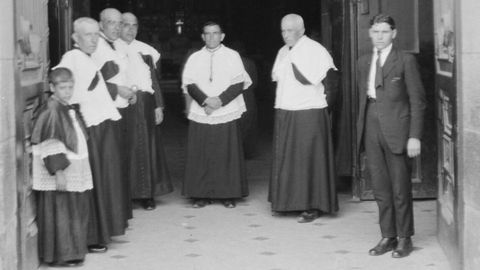
In 1921, the Hispanic Society commissioned her to go to the Iberian Peninsula to develop documentary work based on images of traditional attire, customs, and other manifestations of material culture. From that assignment emerged several visits that resulted in the most complete documentation of Galicia ever produced by a foreign traveler.
During nearly a year and a half in Galician lands, Ruth Matilda Anderson took more than 5,000 photographs, but she also collected others by Galician authors. All of this material ended up in the collections of the Hispanic Society of America, giving rise to two volumes, most notably the legendary volume Gallegan province of Spain. Pontevedra and La Coruña, published in New York in 1939. The volume contains 682 images, a lengthy text, and photographs by Galician authors such as Ksado, Sarabia, and Pacheco, alongside works by other Spanish photographers. It also features works by painters such as Sorolla and Álvarez de Sotomayor. Beyond images, it included other items such as engravings, three-dimensional art objects, documents, maps, and sheet music.
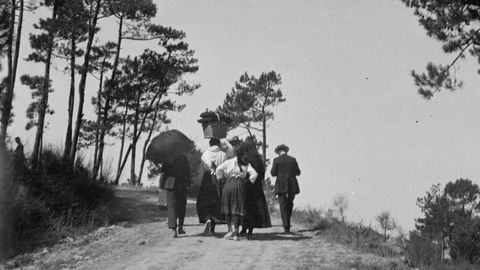
Vaqueiro explains that although the photographer was initially tasked with taking photos of traditional attire and other very specific aspects, she ultimately created a comprehensive «panoramic view» of the region, capturing cities and towns, traditional and religious architecture, artisanal crafts, markets and fairs, maritime and rural labor, portraits, festivals, pazos (country houses), and more. In addition to her photographic eye, Anderson «must have developed a remarkable ability to connect with people, which allowed her access into the homes of common folk and introduced her to key figures of the era's cultural scene, such as César Vaamonde Lores, archivist-librarian of the Galician Academy». Anderson's presence in Galicia, accompanied by young New Yorker Frances Spalding, drew significant attention because they were young, independent, professional women interacting extensively with Galician society at the time.