
Walking the Celtic Way. Discover the historic route connecting the Emerald Isle with Santiago across the sea, following in the footsteps of St. Patrick and the tradition of Gaelic pilgrims
27 ago 2026 . Actualizado a las 16:34 h.It may be one of the less popular Jacobean routes, but it is as old as the English Way (Camino Inglés). Since the 12th century, currachs—traditional wooden and wicker boats—crossed the Atlantic Ocean to transport the first Gaelic pilgrims from the ports of Cork, Limerick, Waterford, or Wexford to the Galician coast. They set sail filled with uncertainty, faith, and the hope of reaching the tomb of the Apostle St. James. They are the origin of An Bóthar go Santiago, the seed of a transatlantic tradition that structured the cultural dialogue between Ireland and Galicia.
However, the Celtic Way has not only been a display of devotion over the centuries, but also a vital refuge that preserved the identity of these peoples with a shared Celtic heritage in both Galicia and Ireland. Elements as emblematic as the Gaelic harp were immortalized in the very stone of the Pórtico de la Gloria in the Cathedral of Santiago, serving as a testament to this ancient exchange. This maritime heritage came alive again in contemporary memory thanks to the late Glen Hansard, who undertook the sea voyage from Dublin to Compostela in a traditional currach he built himself. The musician and composer left the Irish capital in 2014 bound for French Brittany; between 2015 and 2016, he continued the journey along the French Atlantic coast and northern Spain until landing in Galicia and eventually reaching the Plaza del Obradoiro.
Sea or Air Connection
Today, the seafaring spirit lives on through the Celtic Way, a mixed format connecting the Emerald Isle with the Galician capital. Although it is not an official land route, the Cathedral of Santiago and the Camino Society Ireland have an administrative agreement validating this itinerary: pilgrims walk a certified minimum of 25 kilometers on Irish soil and complete the remaining 75 kilometers of the English Way from A Coruña to Santiago. By completing the minimum 100 kilometers required by the Pilgrim’s Reception Office, walkers obtain the coveted Compostela certificate by presenting the stamped credential issued by the Camino Society Ireland, even if completing the route requires a sea or air connection.
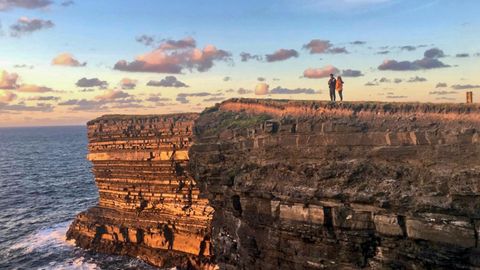
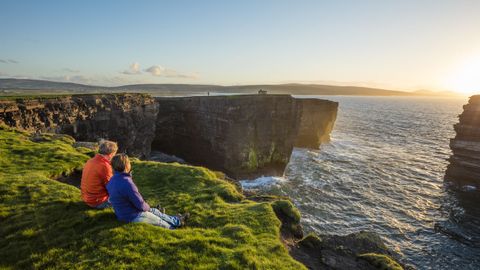
On the Irish side, more than one route is offered: organizations such as the Camino Society Ireland recognize up to nine recommended paths—notably the Bray Celtic Camino, the Kerry Camino, or the historic Tóchar Phádraig. «The Irish routes are mostly individual stretches that offer a leisurely experience, ideal for those seeking introspection away from the crowds», explains Michael Walsh, a board member of the society. In Ireland, waymarking is carried out by local community associations, and accommodations consist of the conventional hotel network, unlike the well-known network of public hostels in Spain.
And while it may not be as popular on this side of the Atlantic, its impact on Irish society is evident: last year, 10,794 citizens obtained the Compostela, breaking their own record and placing Ireland seventh among foreign nationalities on the Jacobean route, ahead of France.
Today's Irish pilgrim undertakes the trek driven by a mix of faith, spirituality, hiking, charitable causes, «or simply the desire to fulfill a personal dream before dying», Walsh reflects. But originally, this mode of travel had a strong religious component linked to the island's evangelizer: St. Patrick. The man who explained the mystery of the Holy Trinity holding a shamrock in his hand laid the foundations of Irish spirituality. For those seeking an authentic, uncrowded experience, the St. Patrick’s Way offers a 131-kilometer journey between Armagh and Downpatrick in Northern Ireland—an itinerary that invites pilgrims to trade the scallop shell for the shamrock and immerse themselves in an unspoiled Ireland.
In the Footsteps of St. Patrick
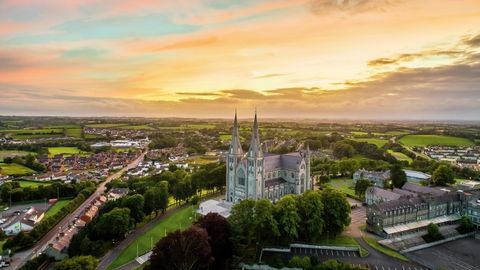
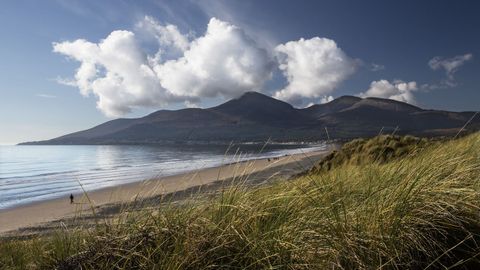
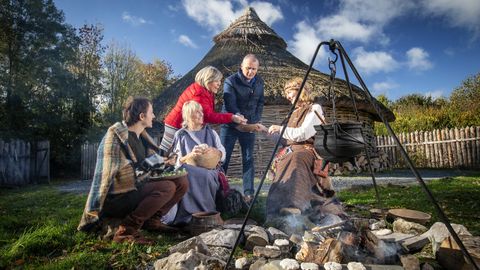
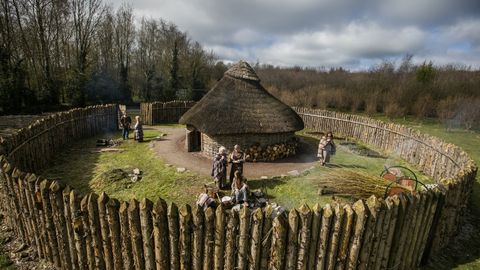
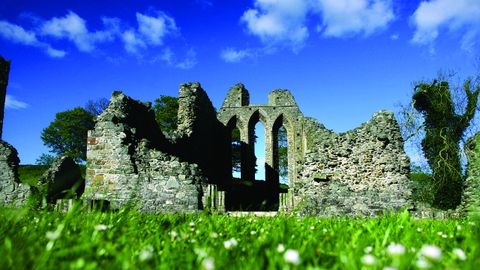
St. Patrick's journey begins in historic Armagh, where the saint erected his first church and where two imposing cathedrals now face each other atop opposing hills. After getting their credential stamped at the Navan Centre & Fort—a mythical enclave surrounded by the legendary apple trees used to make the region's traditional cider—the walker heads toward Newry, the «Gateway to the North», flanked by the peaks of the Mourne Mountains and the Ring of Gullion. The route winds through artisan workshops, landscapes of the Murlough Bay Nature Reserve, monastic ruins, and the striking sight of Dundrum Castle, ending in Saul and Downpatrick—the resting place of Ireland's patron saint and home to the Saint Patrick Centre, which displays the living memory of his legacy.
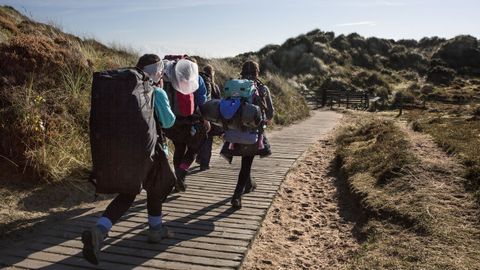
Whether choosing the combined Celtic Way between Ireland and A Coruña or following in the footsteps of St. Patrick in the north of the island, pilgrims face a common challenge: the weather. With abundant rainfall in both latitudes, waterproof clothing becomes an indispensable basic piece of gear. As walkers themselves point out, completing more than the minimum 25 kilometers on Irish soil is «essential for warming up the legs and preparing the body» before tackling the intensity of the Galician section.
Those who have done it agree on the similarity of the landscapes in both territories, and that walking these paths is much more than covering kilometers: «It is a unique opportunity to reconnect with pure nature and feel, with every step between Irish green and Galician stone, the immortal heartbeat of ancient ancestors»" concludes the member of the Camino Society Ireland.