The Viking legacy along the English Camino: «In search of the riches of northern Galicia»

VEN A GALICIA
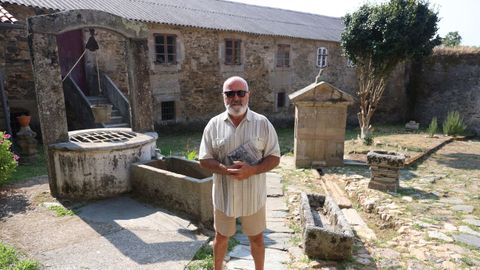
Books and local festivals delve into a past shaped by Norse invasions, whose maritime routes would later be followed by Christian pilgrims
04 ago 2026 . Actualizado a las 15:39 h.Prosperity seemed to be blowing in with the winds in the year 968 for the Viking titan Gunderedo. Known as the King of the Sea—or Gunrod or Gudrød to his fellow Norwegians—this formidable chieftain had just laid waste to the French Loire Valley. The he turned his gaze toward the lush green shores of Galicia. «The Vikings were hunting the wealth of northern Galicia, especially the Ferrol estuary, which functioned like a calm inland sea rich in tin, copper, and food supplies». This is how museology specialist, researcher, and author Benjamín Hermida González explains it from the monastery of O Couto in Narón, where he serves as a guide. The monastery stands along the English Camino to Santiago and traces its origins back to the ninth century, although it reached its greatest splendor after joining the Order of Cluny in the twelfth century. «It suffered two major Viking attacks: the first in 844, and then Gunderedo's assault between 968 and 970», says Hermida González. The great Nordic fleets sailed through the very same estuaries and maritime routes that medieval pilgrims would later follow along the pilgrimage roads to Santiago, transforming waterways once associated with conquest into paths defined by faith.
The Vikings reached what they called Jakobsland (Galicia) in four separate waves between 844 and 1066. During the first, they landed at Faro Brigantium, near Clunia (modern-day A Coruña), where King Ramiro I's army awaited them. In later expeditions, they laid siege to Compostela in an attempt to seize its riches. In his novel Gudrød, 970. Los drakkar ártabros, Hermida draws on the Viking attacks against the Ferrol estuary «to create a historical novel recounting both the assaults on O Couto and the attack on another monastery in Neda that has since disappeared, as well as on the ancient Roman settlements in Mugardos».
«Pure Hollywood style»
Speaking about O Couto (San Martiño de Xuvia), Hermida remarks: «I always say that beneath this monastery lie two others. The original ninth-century monastery was destroyed during the first Viking invasion in 844 in what was essentially an all-out pirate raid—utterly ruthless, pure Hollywood style. They smashed everything they found, set it ablaze, and sailed away from an estuary that was defended with catapults».
The raiders came from Norway, Denmark, and Iceland. Over the centuries they struck repeatedly along the Iberian Peninsula before sailing around the European continent as far as Constantinople—present-day Istanbul. Following the first Viking incursion of the ninth century, O Couto was rebuilt by Duke Argimiro, a cousin of King Ramiro I, as a fortified double monastery housing both monks and nuns. The novel Gudrød, 970 is set against the arrival of «that Norwegian chieftain, a relative of King Harald, who came with more than 200 ships intending to turn Galicia into a new Normandy by advancing inland along the rivers, the foundation of every civilization». Between 968 and 970, O Couto served as the headquarters of Saint Rosendo—Bishop of Mondoñedo, abbot, and Viceroy of Galicia—who fought against the Viking invaders. The novel also explores «the conflict between the abbot and the abbess, both of whom belonged to noble families».
Some researchers suggest that Gunderedo may have met his defeat off the Bezoucos Peninsula (Ares and Mugardos), «although the Norwegians are reluctant to accept that the battle ended that way, since they continued their raids across Europe afterward».
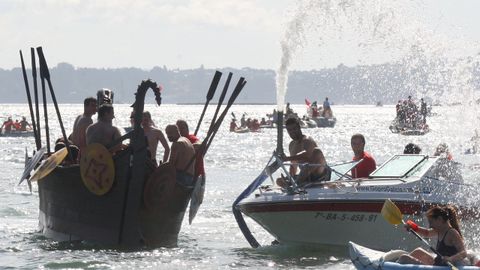
As a legacy of that Nordic bloodline, echoes of those stories still linger in the churches along the English Camino and even in local festivals—such as the once-renowned Viking Invasion reenactment held between Limodre and Redes, from Fene to Ares, or the Viking-inspired touches featured in medieval fairs like those in Pontedeume and A Coruña. Together, they commemorate that final great confrontation between Saint Rosendo, commanding an army of 20,000 soldiers, and Gunderedo, who led 2,000 warriors aboard his drakkars. Nearly eleven centuries later, many pilgrims—particularly those from Ukraine, Scotland, and Ireland—remain captivated by this remarkable episode.
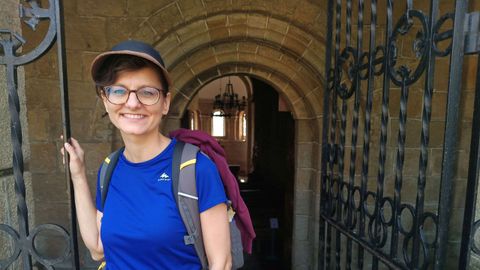
Sonia Piórek, pilgrim: «My heart was broken and the Camino changed my life»
Sonia Piórek, a Polish pilgrim with a passion for Galicia, a deep Catholic faith, and a love of history, is walking the English Camino from Ferrol to Santiago.
—Is this your first time walking the English Camino?
—I come from Wroc?aw, and four years ago I walked the Portuguese Camino. I had been very curious about the English Camino starting in Ferrol because it's so short and lies in the far north of Spain. It seemed like the perfect journey for me. This time I'm walking with a group of 29 people, all from Poland, mainly from the cities of Wroc?aw and Opole in the Silesia region. But as I mentioned, four years ago I walked from Porto to Santiago because my main goal was to find a new beginning in life.
—Why? What was happening in your life at the time?
—I came to Galicia praying because my heart was broken after a bad relationship, and I really needed this experience, you know? Then, just two weeks after completing the Camino and returning home, I found a new apartment because a friend offered me a place to rent at a very low price. I ended up with a flat right in the center of my city—and very close to my workplace! (laughs).
—So it really changed your life.
—It changed my life—yes, absolutely! I feel like a completely new person now, so it has been an incredible experience for me.
—Many pilgrims talk about the Camino's transformative power.
—In my case, I have different intentions in life now. But that's not the only reason I've come back to the Camino de Santiago, this time on a different route. For me, this journey is also a way of reconnecting with my soul. I also enjoy discovering the history of the places the route passes through, including their Viking heritage. And finally, on this new journey through Galicia, I'd love to meet new people and make good friends. So I hope it will be a wonderful experience.
From Ukraine to South Korea, drawn by the power of faith and history
«We welcome pilgrims from Colombia, Mexico, Wales, Ukraine, Poland, Thailand, South Korea, Australia, Argentina, Venezuela, Italy, and Portugal... Those are the countries most commonly represented here. In fact, we're almost more surprised when someone arrives from the Ferrol estuary itself», say Benjamín Hermida and María Josefa Rial, guides at the Monastery of San Martiño de Xuvia. It is in the chapter house of this monastery in Narón that Hermida will present his latest book on August 8, accompanied by archaeologist and historian Andrés Pena Graña.
Pilgrims following the routes to Santiago are drawn not only by the power of faith but also by the pull of history. In the ninth century, rumors spread across northern Europe that the tomb of the Apostle James concealed immense treasures. Pursuing that promise, Viking fleets set sail for what they called Jakobsland—the Land of Saint James—giving rise to centuries of chronicles, legends, and enduring myths.